
See what needs attention
Coverage, missing authorization and incomplete claim details remain visible to the billing team.
REVENUE CYCLE MANAGEMENT
Connect eligibility, encounter details, claim scrubbing and payer responses on one patient record. Mox prepares the work; your billing team reviews the decisions.
The encounter, supporting evidence and payer response stay together.
Illustrative workflow · Staff review corrections and submissions.
HOW THE WORK MOVES
Reduce re-entry and find correctable issues while staff still have time to act.
Review 270/271 eligibility, subscriber details and available benefits before the visit. Use optional ICD-10 and CPT prompts with the encounter; staff review suggested codes.
Prepare the 837P claim and check required fields, provider information, diagnosis pointers and authorization details before an authorized person submits.
Follow acknowledgments and 277 status responses, post 835 ERAs, and keep payer adjustments and patient responsibility connected to the claim and invoice.
BUILT INTO THE WORKFLOW
Bring the payer reason, affected claim, encounter documentation and correction history together. Mox can suggest the next step without separating it from the source.
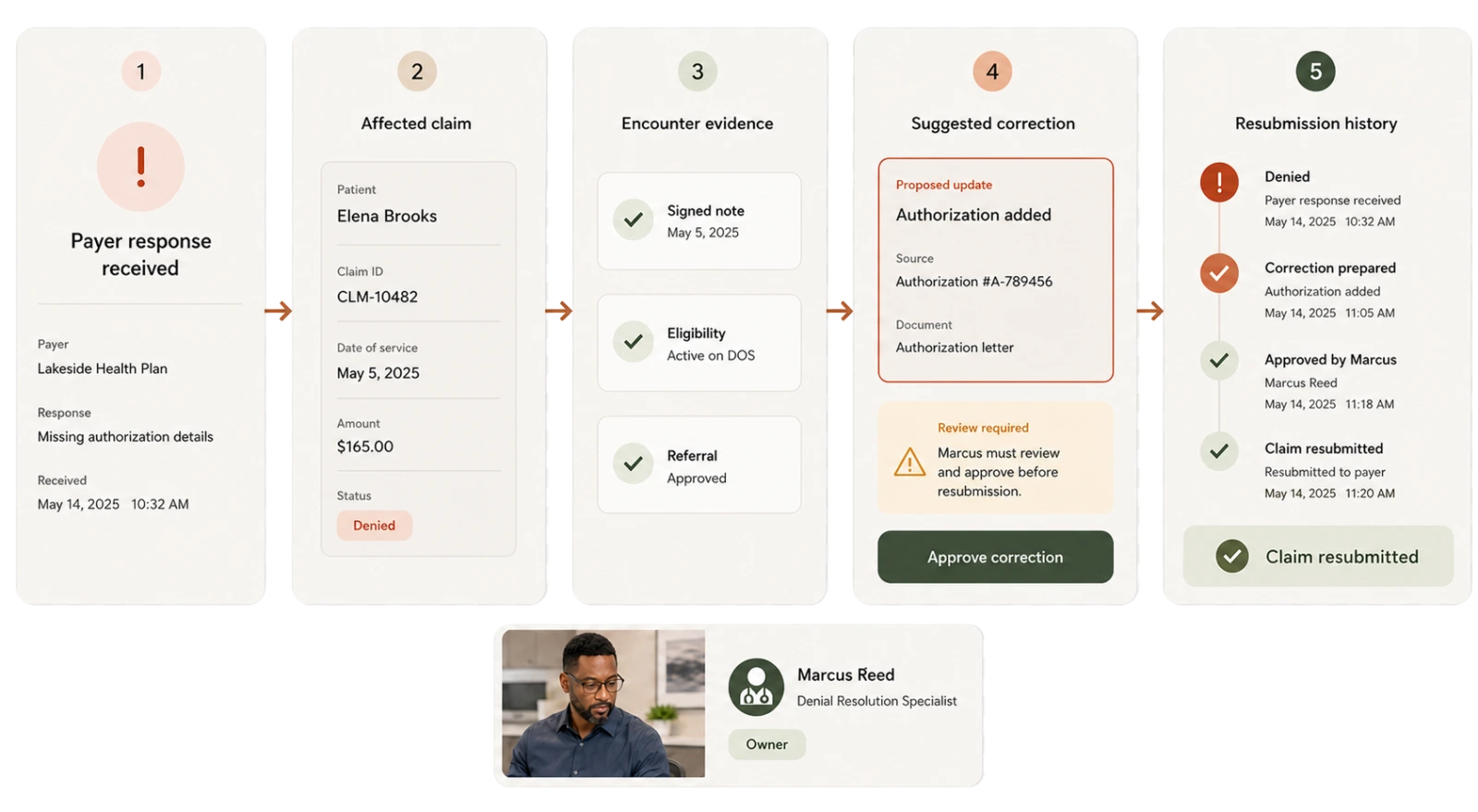
Coverage, missing authorization and incomplete claim details remain visible to the billing team.
An authorized person checks the evidence and proposed change before it is applied or resubmitted.
Preserve payer responses, ownership, approvals and resubmission events in attributable, append-only history.
SEE IT IN PRACTICE
Follow claim preparation, coding prompts, scrubbing, submission and status tracking from the encounter.
Follow claim preparation, coding prompts, scrubbing, submission and status tracking from the encounter.
CLEAR RESPONSIBILITIES
Your clinic retains coding decisions, payer relationships and control of collections. Eligibility and an accepted submission do not guarantee payment. Moxcares uses software and transaction pricing rather than a share of revenue; payers deposit directly into your clinic's account.
Explore the Trust CenterUNDERSTAND THE ECONOMICS
Use your own figures to estimate the fee in a percentage-based contract. Then compare service scope, staffing and Moxcares software and transaction costs—not just the headline number.
Review plans and usageEstimated monthly billing fee
$7,200
Estimated annual billing fee
$86,400
Illustrative estimate only. Actual contracts and services vary.
BEFORE YOU DECIDE
No. Moxcares is revenue-cycle-management software with AI-assisted workflows. Your clinic retains control of coding, corrections, submissions and payer relationships.
Moxcares supports professional 837P claims.
Yes. Real-time 270/271 eligibility can surface coverage, co-pay, deductible and information requiring staff review. Available detail depends on the payer; eligibility is not a guarantee of payment.
Electronic acknowledgments and 277 status responses appear in the claims workflow. An accepted submission is not the same as a paid claim; staff can follow payer status and remittance details through the next steps.
Moxcares supports 835 ERA posting against the associated claim, invoice and patient balance.
No. Moxcares uses transparent software and transaction pricing rather than taking a percentage of clinic collections.
The denial workflow keeps the payer response, affected claim, encounter evidence, owner, proposed correction and resubmission history together.
Mox may prepare a suggested correction. Authorized staff review the correction before it is applied or resubmitted.

A practical ownership map, claim follow-up process and downloadable weekly review worksheet.

Test source-linked suggestions, documentation gaps, effective dates and the handoff to billing.

RCM charges 4–9% of collections. Modern clearinghouse rails make flat pricing possible.
YOUR PRACTICE. YOUR PACE.
Bring your toughest workflow. We’ll show you how Moxcares can help—and what moving over would look like.
Show me my workflowA focused conversation. A practical next step.