
Verifications and claims
Eligibility before the visit. Claims after it.
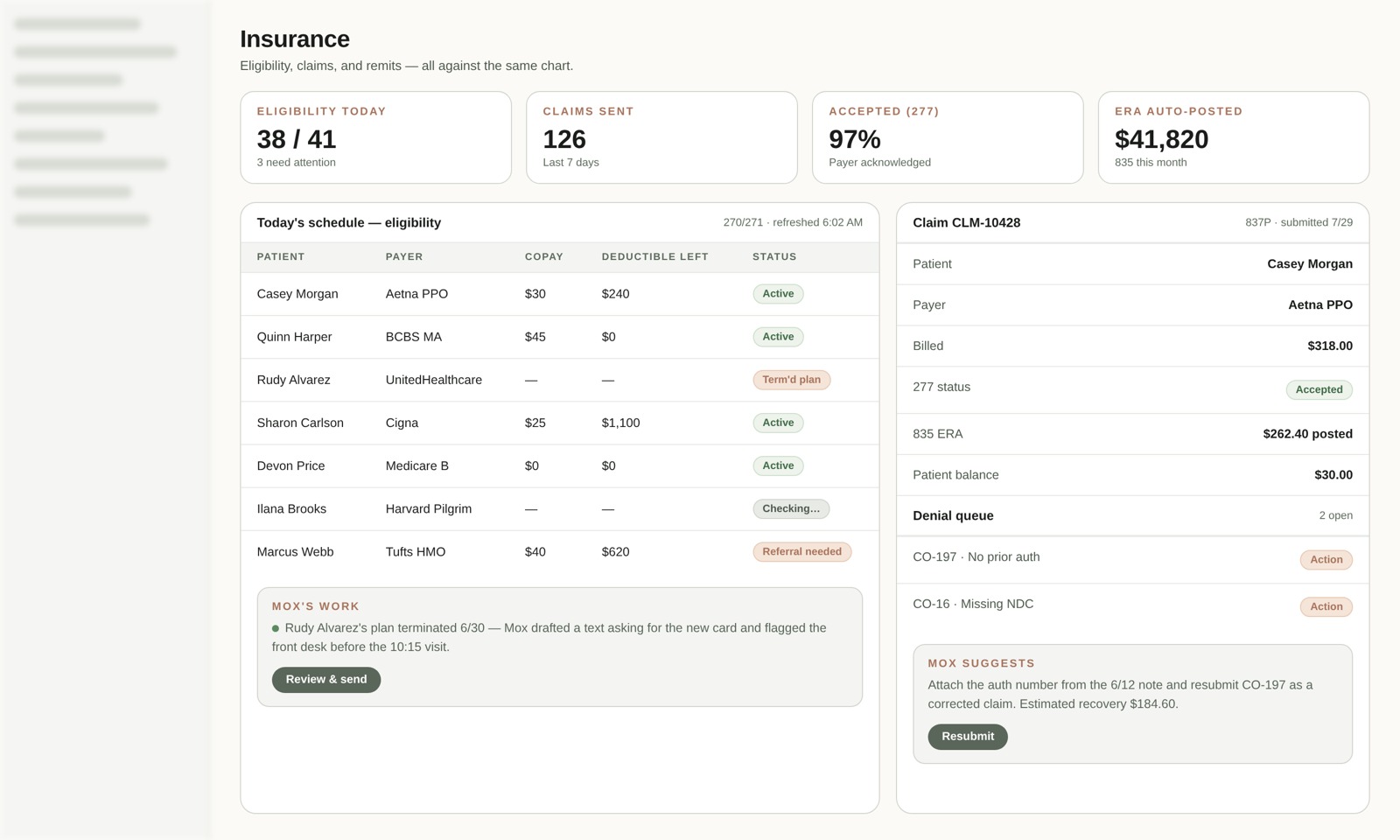
Real-time 270/271, 837P claims, 277 status, and 835 ERA auto-posting — plus a denial queue Mox helps you actually clear. All inside the same chart.
The problem
Insurance is split across three different systems.
Eligibility checks, claim submission, and patient communication rarely share the same record — so staff spend the day logging in, copying out, and chasing down answers.

Eligibility lives in one portal
Staff log into a payer or clearinghouse site to check benefits. The result is copy-pasted into a note, or worse, memorized.
Claims live in another system
Codes are exported, reformatted, and uploaded somewhere else. Status checks mean phone calls or a second login.
Patient communication is separate again
Copay questions, prior-auth updates, and denial notices travel through personal phones, email, or portals no one checks.
Reconciliation is a staff task
When the ERA finally arrives, someone manually posts it to the ledger, chases down discrepancies, and explains the balance to the patient.
What we built
The full RCM loop, from booking to balance.
Eligibility checks run before the patient even arrives. Claims generate from the visit, status updates flow in, and payments reconcile against the same record. Mox works the loop so staff do not have to.
Eligibility verified
Real-time 270/271 runs at booking and again before arrival. Plan, copay, deductible state — the fine print aggregated readably.
Claim generated
Charges captured in the chart during the visit flow straight into an 837P claim. No export, no reformatting.
Status tracked
277 responses stream into the queue. Accepted, rejected, pending — visible without a phone call to the payer.
ERA auto-posted
835 ERAs post against the claim, the invoice, and the patient balance in one pass. Manual posting becomes the exception.
Denial queue cleared
Denials land with the reason, payer, and Mox's suggested fix. Rework happens in-line instead of stacking up.
Fair pricing
Per-check metering for verified benefits. No per-provider claim seats, no upload limits, no volume tiers to negotiate.
Why this is different
One system, one spine, one chart.
Mox automates claim generation, balance reconciliation, and patient follow-ups on the same record as the visit. No staff interference, no separate logins, and no reconciliation between tools that were never built to talk.
What you get
The full RCM loop, without a second system.
Real-time eligibility (270/271)
Every appointment runs an eligibility check the night before and again on arrival. Copay, deductible, and coverage status show right in the schedule.
One-click 837P claims
Codes flow from the note. Scrub, submit, and track — no separate claims tool, no double entry.
Claim status without phone calls
277 responses stream back into the queue automatically. You see 'accepted', 'rejected', or 'pending' without dialing a payer line.
ERA auto-posting (835)
When the payer pays, the ERA posts against the claim, the patient balance, and the ledger. Manual posting becomes an exception, not a workflow.
A denial queue that gets worked
Denials land in a sortable queue with the reason, the payer, and Mox's suggested next step. Rework happens in-line instead of piling up.
Verification as an add-on
Front-desk teams can also request verified benefits (deductibles remaining, plan year, prior-auth flags) on demand for a flat per-check price.